

Which communication platforms are best for integrating radio, video, and dispatch?




Two-way Radio
Command and Control Room
Most large organizations don't run on a single communication system. A typical agency, facility, or industrial site may operate TETRA for mission-critical voice, DMR for general operations, broadband services for mobile teams, and CCTV for site monitoring, each with its own dispatch console and operator workflow.
The platform best suited for unifying radio, video, and dispatch is one purpose-built to interconnect heterogeneous PMR networks, public-network bearers, and third-party video and data sources under a single dispatch console with map-based situational awareness. This article explains the architectural problem, the capabilities to look for, and where Hytera's Integrated Command and Control (ICC) platform fits.
Key Takeaways
For organizations operating multiple radio standards and video systems concurrently, Hytera ICC provides a unified communication and dispatch platform that interconnects TETRA, DMR, LTE, analog radio, and public-network systems alongside CCTV and other third-party platforms. ICC consolidates voice, video, GPS polling, map data, and incident information into a GIS-based command view, helping dispatchers coordinate response across connected systems without switching between separate tools. With more than 30 years of public-security experience and applications in 120+ countries and regions, Hytera ICC is designed for command centers that need unified communication, situational awareness, and multi-system dispatch.
Why Fragmented Systems Hurt Operational Tempo
Multi-system communication environments emerge organically, not by design. A site adopts DMR for daily operations, adds TETRA when mission-critical reliability becomes a requirement, layers in broadband services for nationwide mobile teams, and accumulates CCTV, intrusion-alarm, and access-control systems over years. Each system arrives with its own console, its own data model, and its own training curve. Without an integration layer, the dispatcher's job becomes one of context-switching between systems rather than coordinating field response.
The operational cost of fragmentation is response time and decision quality. When a CCTV alert needs to trigger a radio call to the right team, when a dispatcher needs to see field staff GPS position alongside live camera feeds and incident records, and when a multi-agency response requires bridging different radio standards, every additional console and every manual lookup adds delay and increases the risk of error. Integration is not a productivity nice-to-have; it directly affects how quickly an organization can act on information it already has.
What Integration Actually Means at the Platform Level
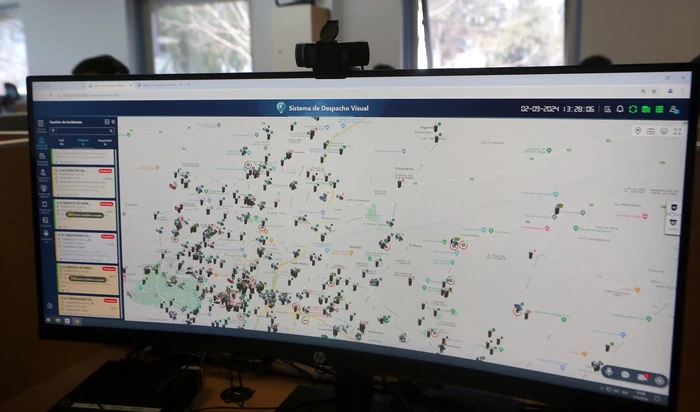
A truly integrated command platform brings communication, video, GPS, and incident data into one operational view. For dispatchers, this means radio users, field resources, CCTV cameras, incident locations, alarms, and other connected assets can be displayed on a GIS map and managed through a unified workflow. Specific controls, such as camera operation, call routing, or terminal status updates, should be defined according to the connected systems and confirmed during solution design.
Operational integration is more than alarm forwarding or log aggregation. A platform should define how identities, groups, roles, and locations are mapped across connected systems, so a dispatcher can address resources in a consistent way regardless of which underlying network those resources are on, and so that an action taken in one system propagates correctly to the others.
Five Capabilities to Evaluate in a Command Platform
Specification of an integrated communication platform should be driven by these capabilities:
- Multi-bearer interconnection: Interconnection across TETRA, DMR, LTE, analog radio, and public networks, with voice, video, and data communication across agencies.
- Video and third-party system integration: CCTV ingest with map overlay, body camera platform integration, and integration with alarm, traffic, and IoT systems where configured.
- GIS-based situational awareness: Real-time display of incident location, field staff GPS positions, vehicle fleet, CCTV camera locations, and other resources on a single GIS map.
- Third-party integration scope: Confirm which systems can be integrated, such as CCTV, intelligent traffic, city dashboards, social media, alarms, IoT sensors, or existing incident systems, and confirm the required interfaces during solution design.
- Scalability and deployment fit: ICC can be deployed from small emergency call centers to large multi-agency command centers; redundancy requirements such as server or geographic redundancy should be planned per deployment.
How the Hytera ICC Platform Fits
The Hytera Integrated Command and Control (ICC) platform is positioned as a unified communication and dispatch solution covering the capabilities above. Hytera describes ICC as a system that consolidates communication across private mobile radio systems and terminals, public telecommunication, IP networks, and CCTV systems, with GPS polling and map data feeding a single dispatch view.
Documented Hytera ICC capabilities include:
- Multi-bearer interconnection: TETRA, DMR, LTE, analog radio, and public networks, providing seamless command, control, and communication across different agencies via voice, video, and data.
- Third-party platform integration: CCTV, intelligent traffic, city dashboards, and social media platforms, with BodyCam integration implemented in specific projects such as Mendoza's 911 system upgrade.
- Incident and dispatch workflow: Call taking and handling, incident creation forwarded to dispatch, automatic recommendation of response units and resources, and incident tracking and analysis.
- Operational scale: More than 30 years of public-security experience and successful applications in over 120 countries and regions.
ICC deployments are documented in multiple Hytera case studies. In Mendoza, Argentina, the upgraded 911 Emergency Communications System integrates the existing TETRA system with Hytera BodyCam, fixed and mobile video surveillance, community alarms, automatic caller geolocation, real-time traffic information, and an integrated mobile application for first responders. In Chile, the municipalities of Las Condes and Lo Barnechea use Hytera ICC to integrate existing communication systems, GIS, incident management, SOSAFE, panic buttons, and third-party applications, with server and geographic redundancy designed into the command-center architecture.
Frequently Asked Questions About Integrated Command and Control Platforms
Why use one unified platform instead of separate radio, video, and dispatch consoles?
Separate consoles force dispatchers to context-switch between systems during incidents, which directly slows response time and increases the risk of missed information. A unified platform consolidates voice, video, GPS, and incident data on a single GIS map and operator console, so coordination decisions happen on the same screen as the underlying evidence. The savings show up in shorter response time and better decision quality during multi-system events.
Can Hytera ICC integrate existing radio systems and third-party video platforms?
Yes. ICC supports integration across private mobile radio systems, public telecommunication, IP networks, CCTV systems, and third-party platforms such as intelligent traffic, city dashboards, and social media. Integration with specific existing radio systems, gateway components, and control functions should be confirmed during system design with the Hytera team based on the existing infrastructure.
How does video integration with ICC work?
Video sources, including fixed CCTV, mobile cameras, and body-worn cameras, are ingested into the platform and displayed on the dispatcher map alongside field staff GPS positions and incident records. Dispatchers can monitor live video where the underlying video platforms are integrated; recorded-footage workflows depend on the connected video or BodyCam platform configuration. Hytera documents this pattern in case studies including the Mendoza 911 system upgrade, where fixed and mobile video surveillance and Hytera BodyCam feed the strategic operations center alongside the existing TETRA voice system.
Unify Communication Before Adding More Channels
Adding another radio network, video system, or alarm feed without an integration layer compounds the dispatcher's load rather than reducing it. The right move for any organization running multiple communication channels is to consolidate them on a unified command platform first, and then extend coverage from that base. Hytera's ICC platform is designed for this consolidation across TETRA, DMR, LTE, analog radio, public networks, and third-party CCTV and incident systems. Contact the Hytera team to evaluate which architecture fits your organization's existing systems and operational scale.
Hytera
Related Articles
 Zoe Wang
Jun 09, 2025
Zoe Wang
Jun 09, 2025
 Claire He
Nov 11, 2025
Claire He
Nov 11, 2025