

Any recommended radio for warehouse use?




Two-way Radio
Two-way Radios
Warehouse operations run on voice coordination. From inbound receiving to pick-and-pack, fork-lift dispatch to outbound loading, supervisors and floor staff need instant, reliable communication across the facility at all times.
The radio technology that works best in a warehouse depends primarily on the size of the facility and whether the site is served by stable Wi-Fi or cellular coverage. This article explains how to choose between a DMR direct-mode setup and a POC solution, with specific product recommendations for each scenario.
The Essentials
For small and mid-size warehouses where communication range is limited to a single building or compact site, a DMR direct-mode configuration using an entry-level handheld such as the Hytera S1 Pro or a model from the BD series is a practical, low-infrastructure choice. For large warehouses and multi-building distribution centers, Hytera recommends POC (Push-to-Talk over Cellular) handhelds, specifically the P50 Pro and P50, which route voice and data over public cellular networks and, where deployed, WLAN, enabling wide-area coordination without dedicated radio spectrum or tower construction.
How Indoor Warehouse Environments Stress Radio Performance
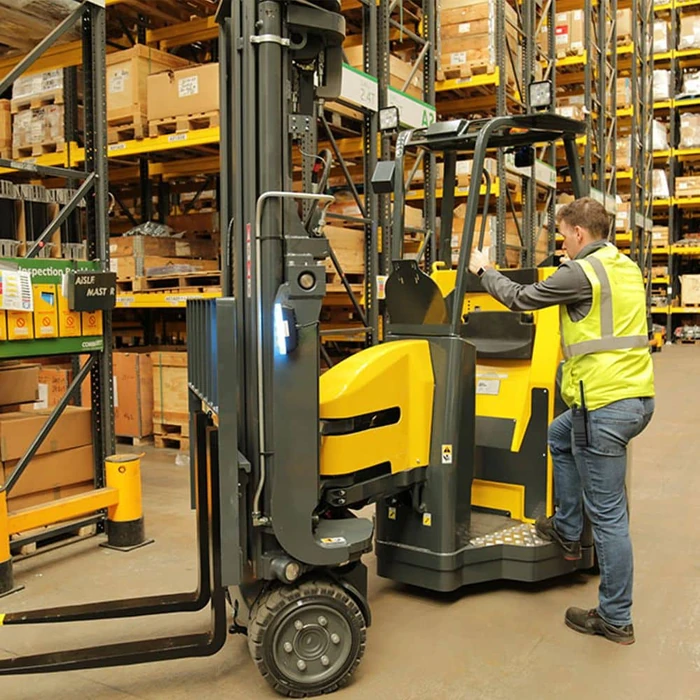
Indoor radio propagation in warehouses is fundamentally different from open outdoor environments. Metal racking, concrete load-bearing columns, elevated storage systems, and continuously moving forklifts create challenging RF conditions: signal reflection, absorption, and shadow zones are common throughout typical warehouse floor plans. A radio that delivers strong outdoor performance may leave staff with degraded audio in dense storage aisles or basement loading docks.
Shift patterns and operational scale further shape the right choice. A compact warehouse with 10 to 20 staff on a single floor has entirely different communication requirements from a 50,000-square-metre distribution hub operating multiple departments, staggered shifts, and dynamic team structures. Getting the infrastructure match right from the outset avoids the cost of premature system redesign as operations grow.
Four Factors That Drive Warehouse Radio Selection
Before choosing specific hardware, assess the site against these four operational criteria:
- Coverage area and layout: DMR direct-mode radios communicate peer-to-peer within a limited range and work well in single-floor or compact sites. Larger facilities with multiple floors, separate buildings, or outdoor loading yards require broader coverage reach, which POC handles through cellular and Wi-Fi networks.
- Licensed spectrum availability: In regions where PMR446 licence-free operation is permitted, certain S1 Pro models can be deployed without an individual spectrum licence. For licensed S1 Pro variants, BD-series radios, and markets outside the PMR446 framework, local frequency and licensing requirements must be confirmed. POC removes this complexity entirely by routing over existing carrier infrastructure.
- On-site network infrastructure: POC devices connect over public cellular networks and site WLAN. If the warehouse already has adequate coverage or a reliable Wi-Fi network, deploying POC radios involves minimal additional infrastructure investment. A site-wide coverage and bandwidth audit is recommended before deploying POC over Wi-Fi to confirm signal quality and capacity across all operational zones.
- Team size and budget: Entry-level DMR handhelds offer low per-unit cost with no system integration overhead. POC handhelds require a PoC platform service such as Hytera HyTalk, with subscription or hosted-service models varying by region, but they return richer capabilities including real-time GPS tracking, push messaging, and centralised device management.
DMR Direct Mode for Small and Mid-size Warehouses
For warehouses where communication range is contained within a single building or compact site, a DMR direct-mode setup delivers clear, instant voice communication with no repeater or base station required. Direct-mode radios connect peer-to-peer, supporting push-to-talk communication, private calls, and group calls, making them straightforward for floor staff to operate with minimal training.
Hytera offers two entry-level DMR lines suited to this scenario. The S1 Pro series is a lightweight, business-ready digital radio designed for compact-site coordination. Where PMR446 licence-free operation is permitted in your region, the S1 Pro LF variant can be deployed without an individual spectrum licence. The BD505, part of Hytera's BD series, is a more durability-focused option offering IP54 protection and MIL-STD 810 C/D/E/F/G testing alongside digital noise cancellation and dual-timeslot DMR capability. The appropriate model should be selected based on site conditions, durability requirements, and the local licensing route applicable to your market.
POC Handhelds for Large Warehouses and Multi-site Operations
Large distribution centers, multi-building logistics parks, and operations that span indoor and outdoor loading zones present coverage challenges that direct-mode DMR cannot address without dedicated repeater infrastructure.
The Hytera P50 Pro and P50 route voice and data over public cellular data networks and, where deployed, WLAN, so coverage extends wherever the carrier network or warehouse Wi-Fi reaches. Both devices are IP68-rated, carry 4,000 mAh batteries, and deliver 2W rated, 3W max audio output for use in noisy loading and sortation environments. Key differences between the two models:
- P50 Pro: 2 GB RAM / 32 GB storage, numeric keypad for fast user and order-code input, NFC, and an 8 MP / 1080p camera for photo and video capture alongside PTT voice. Well suited to supervisory, quality-check, or logistics coordinator roles that combine voice communication with documentation tasks.
3
- P50: 1 GB RAM / 8 GB storage; lightweight at 190 g; optimised for general floor staff whose primary requirement is reliable PTT voice communication.
8Both models run Android 12. Positioning supports GPS/BDS/GLONASS/Galileo, with a BDS-only configuration available as an option. Additional safety features, including any emergency and worker-safety functions, should be confirmed against the regional firmware version and HyTalk platform configuration before deployment. Because POC deployment requires neither licensed spectrum nor repeater construction, new sites can be brought online significantly faster than a private DMR network when a logistics hub expands or a new facility opens.
Frequently Asked Questions About Warehouse Radio Communications
Can POC radios still function if cellular signal is weak inside the warehouse?
POC radios route communications over public cellular data networks and, where deployed, WLAN. If no usable cellular data bearer or WLAN coverage is available in a given zone, PoC service may be unavailable in that area. A site survey confirming LTE, 3G, and WLAN coverage across all operational areas, including any roaming or handover behaviour, is strongly recommended before deployment.
Do DMR direct-mode radios need a repeater or base station?
No. DMR direct-mode operation connects devices peer-to-peer without any repeater or base station infrastructure. For small warehouses with limited range requirements, this is the standard and most cost-effective approach. If the operation later requires extended coverage across a larger footprint, a licensed DMR repeater-based design can be assessed; compatibility with existing handheld models, frequency bands, and firmware should be confirmed during system planning.
Can DMR and POC radios be used together across one warehouse operation?
Yes, through platform-level integration. Hytera's HyTalk Pro platform supports interconnection between broadband and narrowband communications systems, enabling mixed groups of broadband and narrowband users under a converged PMR-LTE architecture; for DMR-specific integration, confirm the exact terminal and platform configuration with the Hytera team. For single-device flexibility, the Hytera PDC680 is a dual-mode terminal that combines DMR and LTE in one unit and can automatically switch between DMR trunking and LTE networks to select the optimal network.
Match the Radio to Your Warehouse Scale
Smaller warehouses with limited coverage requirements are well served by entry-level DMR direct-mode radios such as the Hytera S1 Pro or BD505. Where PMR446 licence-free operation applies, deployment requires no spectrum licence and minimal infrastructure investment; for other markets, licensing requirements should be confirmed with the Hytera team. Larger logistics operations spanning multiple buildings, sites, or outdoor areas benefit from POC handhelds such as the P50 Pro and P50, which leverage existing cellular and Wi-Fi infrastructure to deliver GPS tracking, scalable team communication, and platform-level management. Contact the Hytera team to evaluate which path fits your facility layout, team size, and operational model.