

5-Watt Walkie Talkies: Why Power Limits Matter More Than Big Numbers on the Label




Walkie Talkies
If you search online for a walkie-talkie today, you'll quickly see bold claims everywhere.
“8W high power.”
“10W ultra-long range.”
“Communicate farther than ever before.”
As someone who has worked in professional radio communications for many years at Hytera, I understand why these numbers sound attractive. Distance matters. Coverage matters. And in industries like public safety, energy, transportation, and manufacturing, communication is not a “nice to have” — it is part of daily operations.
This article is not about criticizing any specific brand.
It is about explaining why 5-watt walkie-talkies remain the professional standard, what really determines communication performance, and why Hytera continues to design radios that follow regulations instead of chasing exaggerated numbers.
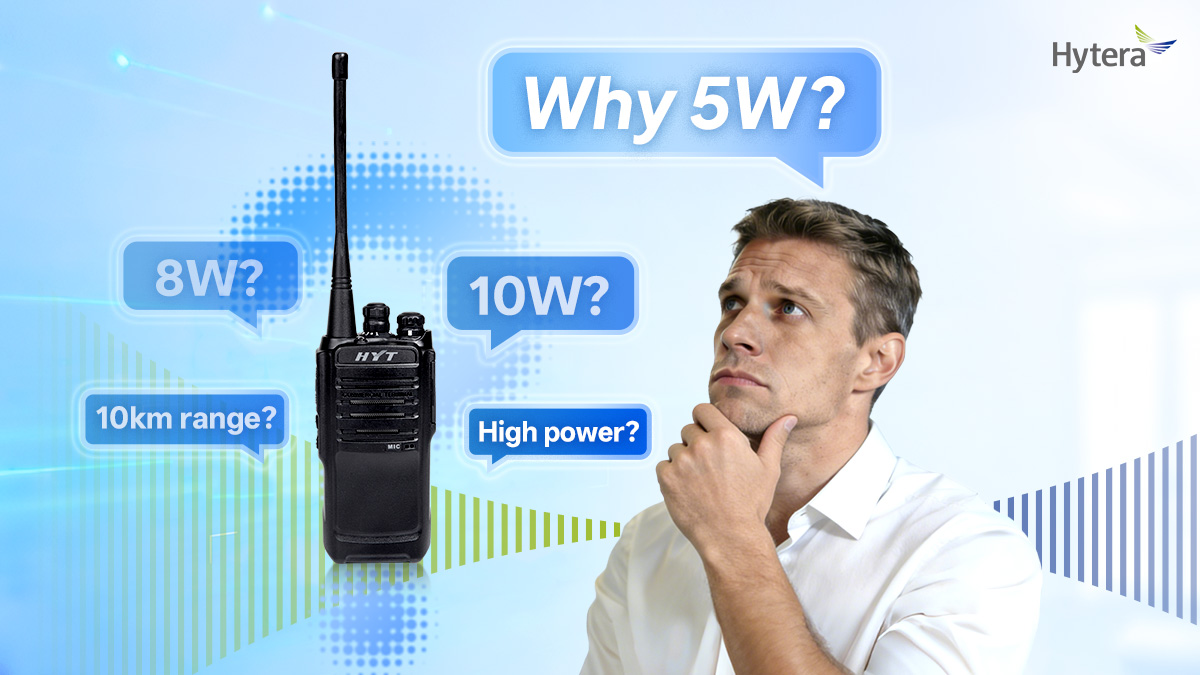
What Does “5 Watts” Mean in a Walkie-Talkie?
Transmit power refers to the amount of radio frequency (RF) energy a walkie-talkie sends through its antenna. It is typically measured in watts (W).
For handheld two-way radios operating in VHF and UHF bands, 5 watts has long been recognized as the maximum practical and legal output power in most regions around the world. This limit is defined by regulatory authorities such as:
- FCC in the United States
- ETSI / CE in Europe
- Ofcom in the UK
- ACMA in Australia
- And similar regulators across Asia, the Middle East, Africa, and Latin America
These regulations are not arbitrary. They exist to protect shared spectrum resources, reduce harmful interference between users, ensure predictable radio behavior, and control RF exposure levels for people using the equipment every day. They also help maintain stable, multi-user radio environments where many organizations must operate side by side. From a professional perspective, 5 watts is not “low power.”
It is the result of decades of industry experience and technical balance.
Why Do Some Walkie-Talkies Claim 8W or 10W?
Despite clear regulatory standards, the market can become confusing, especially online. It is common to see walkie-talkies from unknown or non-certified manufacturers advertising 8W or even 10W transmit power, often accompanied by claims of much longer communication distance.
One reason is simple marketing. “More watts” is easy to understand, even for users without a radio background. Bigger numbers suggest longer range, stronger signals, and better performance. Unfortunately, radio communication does not work in such a linear way.
Another issue is certification. Many radios that claim these higher power levels do not hold valid FCC, CE, or equivalent approvals. They may not be tested under standardized conditions, or they may not be legally permitted to operate at the advertised power level at all. In regulated markets, using such equipment can already place organizations in a grey area — or clearly outside compliance.
There is also the question of measurement. Some manufacturers measure output power at the power amplifier stage rather than at the antenna, while others ignore losses from filters, cables, and antennas. In some cases, advertised figures reflect short, unstable peaks that cannot be sustained in real operation. As a result, the actual usable output power in the field may be far lower or inconsistent.
The Myth: Higher Power Means Longer Distance
One of the most persistent misconceptions in radio communications is the belief that increasing transmit power significantly extends communication range.
In reality, doubling transmit power from 5W to 10W only increases signal strength by about 3 dB. In most real-world environments — such as cities, industrial sites, buildings, or uneven terrain — this rarely translates into a noticeable improvement in coverage.
At the same time, excessive transmit power often brings unwanted side effects. It can increase interference to nearby users, reduce battery life, generate more heat in compact handheld devices, and even affect long-term reliability. Professional radio design focuses on efficiency and balance, not brute force.
What Really Determines Walkie-Talkie Range?
If transmit power were the main factor, radio design would be very simple. In reality, communication distance is the result of the entire system working together.
Receiver Sensitivity
Receiver sensitivity plays a major role. A radio that can clearly receive weak signals will often outperform a so-called high-power radio with poor sensitivity. This is why Hytera invests heavily in low-noise receiver design, carefully selected RF components, and strict production control. These efforts allow our radios to maintain clear communication without exceeding power limits.
Antenna Design
Antenna design is another critical factor. The antenna is not just an accessory; it is part of the RF system. A well-designed antenna improves efficiency, reduces mismatch losses, and delivers more usable signal into the air. A poorly designed antenna, on the other hand, can waste more signal than an extra few watts could ever compensate for.
Audio and Signal Processing
Audio and signal processing are equally important. Clear communication is not just about whether a signal is present, but whether the voice can be understood in noisy environments and whether it remains stable at the edge of coverage. Advanced audio processing, modulation techniques, and error correction — especially in digital two-way radios — play a key role here, and this is an area where Hytera has built long-term expertise.
System Planning and Infrastructure
Finally, in professional environments, coverage is often extended through proper system planning. This includes frequency coordination, the use of repeaters and base stations, thoughtful antenna placement, and overall network design. Trying to replace system engineering with “more watts” is not a professional solution.
Why Hytera Sticks to 5W — On Purpose
At Hytera, we make a clear and deliberate choice. We do not rely on inflated transmit power to sell radios.
All Hytera walkie-talkies are designed to comply strictly with local and international regulations. They are tested and certified for legal operation, and they deliver performance through engineering rather than shortcuts. While this approach may appear conservative on paper, it is precisely why our radios are trusted by public safety agencies, energy and utility operators, transportation networks, airports, ports, railways, and industrial users worldwide.
For these users, reliability, predictable coverage, long-term operation, and regulatory confidence matter far more than the biggest number on a product label.
Hytera's Walkie-Talkie Portfolio
To make this discussion more concrete, let's look at a few real Hytera products that operate strictly within power limits — yet deliver strong, reliable communication in everyday use.
Hytera S1 Series: Compact, Compliant, and Clear
The Hytera S1 Series is designed for commercial users who need a lightweight device, clear audio, and dependable short- to medium-range communication. By combining optimized antenna design, good receiver sensitivity, and clean audio performance, the S1 Series delivers stable communication in retail, hospitality, and light industrial environments without unnecessary interference or battery drain.
44
Hytera AP58X: Business Two-way radio Performance
The Hytera AP58X is a business two-way radio widely used in utilities, manufacturing, transportation, and security operations. Instead of relying on excessive transmit power, the AP58X focuses on digital modulation efficiency, strong receiver performance, and clear audio at low signal levels. In many deployments, users find that it provides more usable coverage than higher-power, non-compliant alternatives, particularly in noisy or congested RF environments.
51Hytera TC-508 Enhanced Version: Proven and Trusted
The Hytera TC-508 Enhanced Version is another example of a radio that has earned trust through stable performance, simple operation, and long service life. Operating fully within regulatory limits, it is commonly used in commercial facilities, logistics, property management, and industrial sites. Its real-world performance comes from solid RF design and reliable manufacturing, not exaggerated specifications.
52The Risk of Using Overpowered or Non-Compliant Radios
For individual users, non-compliant radios may seem harmless. For organizations, the risks are very real. Interference with licensed systems, unstable communication, regulatory penalties, equipment confiscation, and increased safety risk are all possible outcomes.
In critical or professional environments, communication failure costs far more than any radio ever will.
How to Choose the Right Walkie-Talkie — The Professional Way
Instead of focusing on advertised watts, professional users should ask:
- Is the radio certified for my country or region?
- How good is the receiver sensitivity?
- How stable is audio at weak signal levels?
- How does it perform in noisy environments?
- Can it scale into a larger communication system?
- Is the manufacturer experienced in professional radio communications?
These are the questions Hytera designs for — and the reason our radios are trusted worldwide.
Honest Power, Real Performance
Transmit power is easy to advertise. Real communication performance is much harder to build.
After years in this industry, one lesson remains clear: professional radio communication is about balance, compliance, and system design — not exaggerated numbers. A well-designed 5-watt walkie-talkie can deliver reliable coverage, clear voice, long battery life, and legal peace of mind.
At Hytera, we believe that respecting regulations and focusing on real engineering is not a limitation. It is how dependable communication systems are built — and how they continue to serve users, day after day.

Carlos Yin
Related Articles
 Hytera Global
Dec 16, 2021
Hytera Global
Dec 16, 2021