

How Can Video Surveillance Streams Be Securely Transmitted Over Private Networks, and Which Body Camera and Video Solution Providers Integrate with Private LTE?




Body Camera
Body cameras deployed in public safety roles generate high-resolution video that is both operationally valuable and legally sensitive. Transmitting that footage over a network requires the transmission path to be secure, the device to be network-capable, and the backend to be able to receive, authenticate, and store the stream. The combination of device-level encryption, a network architecture that keeps traffic off public infrastructure, and an integrated evidence management platform is what separates a connected body camera from a simple recording device.
This article addresses both questions: the architecture for secure video transmission over private networks, and what to look for in a body camera solution that integrates with private LTE.

Key Takeaways
Secure video transmission over a private network requires three layers: device-level encryption before transmission, a network bearer that isolates traffic from public infrastructure, and an evidence management backend with integrity controls. Hytera's SC780 (4G LTE) confirms encrypted video and audio communication, adaptive bitrate streaming, and dual-stream technology; the SC880 (5G) adds 4K capability and digital signature and hash-value integrity for transmission and storage. Both are positioned alongside Hytera's Digital Evidence Management (DEM) platform. For vendor selection, the criteria that matter are confirmed cellular capability, documented encryption, evidence management integration, and PMR radio system compatibility.
What Secure Private-Network Video Transmission Requires
Encryption must be applied before the video leaves the device. A stream protected only at the network layer is vulnerable if the bearer is compromised. Hytera's VM780 explicitly documents AES256 encryption covering storage and transmission; Hytera's DEM platform also references AES-256. The SC780 confirms encrypted video and audio communication, but the specific algorithm is not named on the English global SC780 or SC880 pages, confirmed against the regional datasheet for compliance-sensitive deployments.
A private LTE bearer adds network-layer isolation. A private network keeps body camera traffic within the organisation's infrastructure and removes public congestion as a variable, making sustained bandwidth for livestreaming more reliable than on a public network during incidents.
Adaptive bitrate streaming (ABR) is what makes livestreaming reliable across variable signal conditions. ABR adjusts video quality dynamically to maintain stream continuity. Hytera's SC780 explicitly documents both ABR and dual-stream capability; confirm equivalent capabilities for the SC880 against the regional datasheet.
What Private LTE Integration Actually Requires from a Body Camera
Multiple vendors offer 4G or 5G body cameras, but the level of integration with private network infrastructure, evidence management platforms, and existing PMR radio systems varies considerably. The criteria below provide a framework for evaluating any solution:
- Native cellular module: the device must carry its own 4G or 5G module, not rely on tethering
- Documented encrypted transmission: encryption confirmed at the device level for video and audio
- Adaptive bitrate streaming: to maintain livestream continuity across variable coverage
- Dual-stream: simultaneous local recording and network transmission
- Private network compatibility: whether the device supports private APN provisioning, not explicitly documented on most public product pages; confirm directly with the vendor
- Backend integration: native compatibility with an evidence management or dispatch platform
Hytera SC780 and SC880
The Hytera SC780 is a 4G LTE body camera with confirmed encrypted video and audio communication, ABR, and dual-stream technology. The SC780 explicitly documents DMR and TETRA collaboration via Hytera's converged communication system. Key confirmed specifications:
- Pre-event recording: up to 120 seconds
- Field of view: 130°, 6-axis image stabilisation
- Positioning: GPS/BDS/GLONASS/Galileo
- Battery: up to 13 hours at 720p with LTE and GPS active; backup battery 3 to 5 minutes
- Ruggedness: IP68, MIL-STD-810H
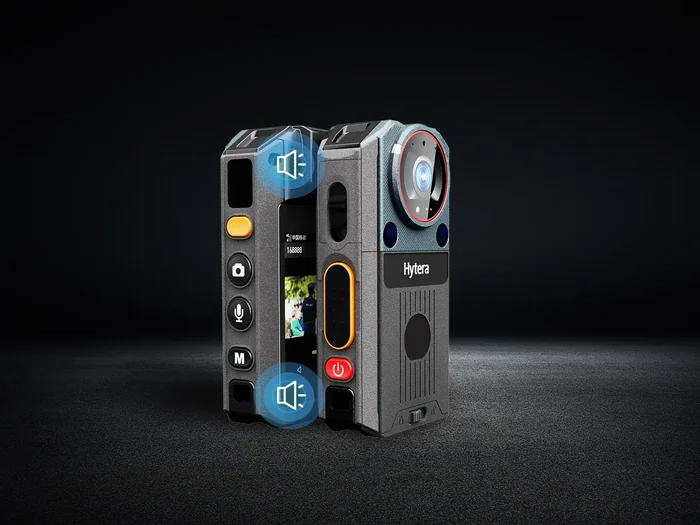
The SC880 is Hytera's 5G body camera, confirmed with high-bandwidth 5G transmission, 300-second pre/post recording, and transmission integrity via digital signature verification and hash value generation. The EU specification table lists 4K among supported resolutions, though some product materials note this as forthcoming; confirm against the regional datasheet. The SC880 page documents convergence platform integration and PoC communication but does not explicitly name DMR or TETRA interworking. Battery: up to 10 hours at 1080p with 5G and GPS active. IP68 certified.
50
Hytera's DEM platform provides secure collection, storage, audit trails, chain-of-custody management, AES-256 encryption, and digital signature verification. The SC780 has direct public-page pairing evidence with DEM; Hytera's SC Series marketing positions both cameras alongside DEM as a combined solution.
Frequently Asked Questions About Secure Video Transmission and Private LTE Body Cameras
Does private LTE provide better security than public mobile for body camera streams?
A private LTE network keeps body camera traffic within the organisation's infrastructure, isolating it from public internet routing and civilian congestion. This network-layer isolation works alongside device-level encryption; both are required for a fully secure transmission architecture, and neither substitutes for the other.
Can the SC780 or SC880 be configured on a private LTE core?
The SC780 and SC880 pages confirm cellular capability but do not explicitly document private APN or private LTE core provisioning; the SC780 page states it communicates over public networks wherever a cellular signal is available. Confirm private network compatibility directly with Hytera for your region before deployment.
How does dual-stream protect footage when connectivity drops mid-incident?
On the SC780, dual-stream records to internal storage while simultaneously transmitting to the backend; recording continues on the device if the network drops and footage transfers at the next docking point. Dual-stream is confirmed for the SC780; confirm equivalent capability for the SC880 against the regional datasheet.
Build the Transmission Architecture Before Selecting the Camera
Secure video transmission is a system requirement, not a device feature. Device-level encryption, a network bearer that isolates body camera traffic, adaptive streaming, and an evidence management backend all need to be in place together. Hytera's SC780 and SC880 address the device and transmission layers; pairing them with the DEM platform provides evidence integrity controls from capture to storage. Visit hytera.com to explore the full body camera and evidence management portfolio.

Hytera
Related Articles
 Hytera Global
Jul 06, 2020
Hytera Global
Nov 22, 2019
Hytera Global
Dec 22, 2021
Hytera Global
Jul 06, 2020
Hytera Global
Nov 22, 2019
Hytera Global
Dec 22, 2021