

What intrinsically safe DMR radio should I consider for a refinery or chemical plant?




PoC & MCS
Two-way Radios
Specifying an intrinsically safe DMR radio for a refinery or chemical plant is a procurement question that should be answered by reading the certification label, not by reading product brochures. The right radio is the one whose ATEX or IECEx marking matches the operating zone, gas group, dust group, and temperature class on your site documentation.
Where the site classification requires Zone 1 IIC gas and Zone 21 IIIC dust, the radio should carry both II 2G Ex ib IIC T4 Gb (gas) and II 2D Ex ib IIIC T120°C Db (dust), or stricter. This article walks through what each part of the marking means, why dual gas-and-dust certification matters for petrochemical sites, and which Hytera DMR radios meet this profile.
The Essentials
For refinery and chemical plant operations classified as Zone 1 IIC gas and Zone 21 IIIC dust, Hytera recommends the HP79XEx IIC and the HP71XEx IIC as the current intrinsically safe DMR portable radios for IIC gas-group hazardous areas. Both carry ATEX II 2G Ex ib IIC T4 Gb (gas) and II 2D Ex ib IIIC T120°C Db (dust) per the Hytera user manuals, with equivalent IECEx markings, IP66/IP68 ingress protection, and a -25°C to +60°C operating range in hazardous areas. For sites that operate a TETRA network instead of DMR, the PT890Ex is the corresponding intrinsically safe TETRA portable. In all cases, the certificate numbers and exact marking on the radio nameplate should be verified against the deployment site's classification before procurement.
Decoding the ATEX Marking on a Radio
An ATEX marking is a compact specification document. A typical hazardous-area DMR portable carries a marking like II 2G Ex ib IIC T4 Gb / II 2D Ex ib IIIC T120°C Db, and each segment of that string is a procurement-relevant data point.
The marking string breaks down as follows:
- II: Equipment Group, with II covering surface industries other than mining.
- 2G / 2D: Equipment Category. Category 2 covers Zone 1 (gas) and Zone 21 (dust), areas where an explosive atmosphere is likely to occur during normal operation. G is gas, D is dust.
- Ex ib: Type of protection. Intrinsic safety, level of protection b, suitable for Zone 1 and Zone 2 equipment marking. Ex ia is the higher level required for Zone 0; Ex ib applies to Zone 1/2 areas as defined by the site classification.
- IIC / IIIC: Gas group or dust group. IIC is the most demanding gas group, covering hydrogen and acetylene; IIIC is the most demanding dust group, covering conductive dust. A radio certified to IIC and IIIC also covers the lower groups IIA, IIB and IIIA, IIIB.
- T4 / T120°C: Temperature class. T4 limits the maximum surface temperature to 135°C in gas atmospheres and is suitable only where the relevant gas or vapour ignition temperature is above 135°C. For dust, the surface temperature is given directly in degrees Celsius rather than as a T-class.
- Gb / Db: Equipment Protection Level. Gb is the Zone 1 gas EPL; Db is the Zone 21 dust EPL.
Reading the marking is non-negotiable, not optional. If the operating zone documentation specifies Zone 1 with IIC gases and conductive dust, the radio must carry both the gas marking (Ex ib IIC T4 Gb or stricter) and the dust marking (Ex ib IIIC with a dust temperature low enough for the site dust). A radio certified for gas alone is not specified for use in a dust-classified area, and vice versa.
Why Dual Gas and Dust Certification Matters
Refineries and chemical plants typically have both gas and dust hazardous zones in close proximity. The same operator may walk from a hydrogen-handling unit (Zone 1, IIC gas) to a sulfur-handling area or a catalyst storage area (Zone 21, conductive or non-conductive dust) within a single shift. Site safety procedures usually require workers to carry one radio across the whole site rather than swap radios between zones.
Dual gas-and-dust certification (II 2G plus II 2D) can reduce the need to swap radios, provided the exact marking matches every classified area the worker may enter. A radio with only gas certification should not be specified for a dust-classified area unless the site authority confirms it is permitted, and a radio with only dust certification should not be specified for a gas-classified area on the same basis. For petrochemical procurement, this is the practical reason to specify dual certification rather than treat gas and dust as separate radio categories.
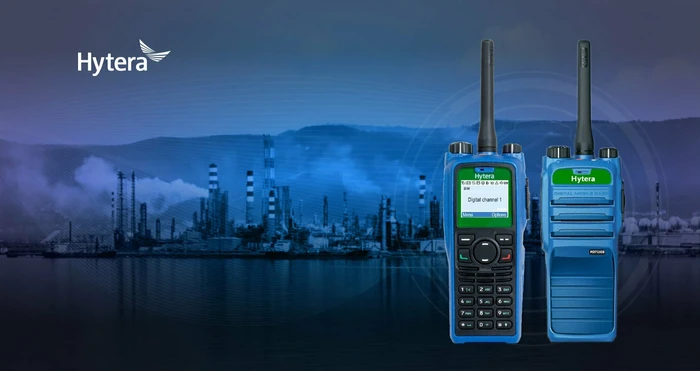
Hytera HP79XEx and HP71XEx for IIC Hazardous Areas
The Hytera HP79XEx IIC is the current flagship intrinsically safe DMR portable for refinery and chemical plant operations. Per the Hytera HP79XEx user manual, the radio carries ATEX I M2 Ex ib I Mb (mining), II 2G Ex ib IIC T4 Gb (gas), and II 2D Ex ib IIIC T120°C Db (dust), with the equivalent IECEx markings. The radio is rated IP66/IP68 for ingress protection and is engineered to operate from -25°C to +60°C in hazardous areas. Features include a 2.4-inch screen, AI-based noise reduction with automatic gain control, a 2 W audio speaker, and worker-safety functions such as a Man Down alarm with location reporting. Hytera positions the HP79XEx for users who need a larger display and more on-device information visibility, such as supervisors and roles that combine voice with data review.
The HP71XEx IIC carries the same ATEX and IECEx marking class as the HP79XEx IIC. Per the Hytera HP71XEx user manual, the radio carries ATEX I M2 Ex ib I Mb, II 2G Ex ib IIC T4 Gb, and II 2D Ex ib IIIC T120°C Db, with equivalent IECEx markings, IP66/IP68 ingress protection, and a -25°C to +60°C operating range. The HP71XEx IIC is positioned for field staff who need IIC hazardous-area certification in a more compact form factor, with a 1.47-inch screen and a streamlined interface for primarily voice-driven workflows.
For sites that include propane-type atmospheres (gas group IIA) rather than IIC, Hytera also produces HP79XEx and HP71XEx variants in the IIA gas group, which can be specified where the higher IIC class is not required by the site classification.
When TETRA Is the Better Fit
For sites with an existing TETRA network or with operational requirements that favour TETRA over DMR, the Hytera PT890Ex is the corresponding intrinsically safe TETRA portable. PT890Ex carries IECEx and ATEX certification, MIL-STD-810H qualification, dust/water protection up to IP68 depending on the regional specification, a 2.4-inch 320 × 240 display, and AI-based noise reduction. It is positioned alongside the HP79XEx as part of Hytera's intrinsically safe portfolio for oil and gas, fire and rescue, airports, and manufacturing. The exact ATEX marking and certificate number should be verified against the regional datasheet.
The choice between DMR and TETRA at a refinery or chemical plant is normally driven by the existing radio infrastructure, dispatch capacity requirements, and budget profile. Both standards have established intrinsically safe terminal options in the Hytera portfolio.
Frequently Asked Questions About IS DMR Radios for Refineries
Is Ex ib sufficient for a refinery, or should I specify Ex ia?
Ex ib is suitable for Zone 1/2 equipment marking, while Zone 0 applications require Ex ia or another marking accepted by the site classification. Whether a radio with Ex ib is sufficient depends on which zones the worker carrying the radio will actually enter; the site explosion risk assessment document should be the authoritative source for which protection level is required at each location.
What does T4 mean in practical terms for a chemical plant?
T4 specifies a maximum equipment surface temperature of 135°C in gas atmospheres. It is suitable only where the relevant gas or vapour ignition temperature is above 135°C. T5 (100°C) and T6 (85°C) are more restrictive classes used where lower-ignition gases are present. The site explosion risk assessment should confirm the ignition temperatures of all gases or vapours present at the deployment area.
Why do dust certifications use temperature in Celsius rather than T-classes?
Dust temperature classes are expressed directly in degrees Celsius (for example T120°C) because the relationship between maximum surface temperature and dust ignition is not the same as for gases. The combustion behaviour of dust depends on the dust composition, layer thickness, and ambient conditions. Site documentation should specify the maximum allowable surface temperature for the dust present, and the radio dust temperature class should be at or below that figure.
Specify by the Marking, Not the Brand
For a refinery or chemical plant intrinsically safe DMR procurement, the controlling document is the operating zone classification, and the selection criterion is whether the radio's marking matches that classification. The Hytera HP79XEx IIC and HP71XEx IIC are the current Hytera DMR portables in the IIC gas-group class, both carrying ATEX II 2G Ex ib IIC T4 Gb (gas) and II 2D Ex ib IIIC T120°C Db (dust) per the official user manuals. For TETRA networks, the PT890Ex is the corresponding intrinsically safe option. Contact the Hytera team to match a specific radio configuration to the zone, gas group, and temperature class documented for your site.