

What Radio System Works for Both Daily Utility Dispatch and Major Outage Restoration? A Deep Dive into DMR Tier III Trunking




Mission Critical
Utility communications run in two modes. Routine operations involve coordinated dispatch across maintenance crews, field teams, and vehicle fleets. A major outage demands that the same network carry simultaneous surge traffic across a wide geographic area, often under degraded conditions.
A system built only for routine load will fail at the moment of highest consequence. This article explains why an independent DMR Tier III trunking network is the right architecture for utility organisations that need both.
Why Basic Radio Setups Fall Short for Utilities
Some operators manage routine work with DMR direct-mode radios. For light daily traffic, this is functional. The limitation becomes structural the moment a major grid fault demands coordinated response across multiple teams and a large service territory.
Direct-mode relies on handset-to-handset propagation. Substations, remote corridors, and dispersed vehicle crews all create gaps that direct-mode has no infrastructure to bridge. Coverage is bounded by radio range, not the operational area.
Public LTE/4G introduces a different risk: the carrier network can experience congestion, site power loss, or backhaul failure during the same event that triggers emergency response. Utilities should not treat public mobile as the sole critical voice path. An independent private network removes that carrier dependency, though it still requires its own engineered redundancy for power, backhaul, sites, and controllers.
Why DMR Tier III Trunking Is the Right Architecture
Unlike DMR Tier II conventional systems, where users are tied to fixed channels, DMR Tier III uses a dedicated control channel to dynamically assign traffic channels from a shared pool. Resources are allocated to active calls as needed rather than reserved per team.
This allows the system to manage surge traffic more efficiently, applying configured priority levels, call queuing, and pre-emption policies when demand peaks. Dispatch administrators can define which teams and call types take precedence, ensuring incident commanders are not blocked by lower-priority traffic during a major response.
Infrastructure Resilience and Contingency Planning
A critical question for utility radio planning is what happens when the infrastructure is affected by the incident itself. Hytera DMR Tier III supports multi-level fallback. In certain configurations, if the link between a base station and the trunking controller is lost, the base station can continue local cell operation for radios registered at that site.
This preserves communication within the affected coverage cell even if the wider network is disrupted. Terminals can also be programmed with conventional channels for peer-to-peer contingency use where both trunking and cell fallback are unavailable. The exact behaviour depends on system design, firmware, and codeplug configuration, and must be validated with Hytera during network planning.
The Hytera DS-6250S: Infrastructure Suited to Utility Sites
The DS-6250S is an outdoor DMR Tier III trunking cube base station based on SDR and multi-carrier architecture. It is rated IP68, operates from -40°C to +55°C, withstands 20 kA lightning and 240 km/h wind loads, and carries an MTBF of 100,000 hours, making it suited to exposed substations and remote infrastructure sites.
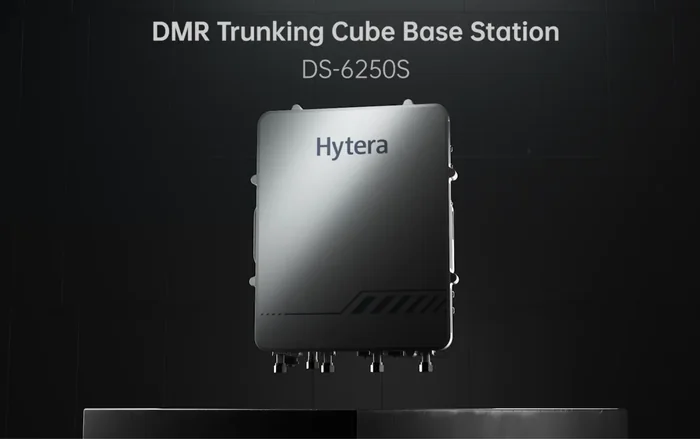
It supports wall, pole, vehicle, and trolley mounting with no equipment room or dedicated cooling required. Hytera positions this design as reducing deployment cost and time by eliminating the shelter and auxiliary infrastructure that conventional base station installations need. In UHF configuration it supports up to 8 carriers, with built-in GPS/Beidou/GLONASS/Galileo synchronisation and 1+1 redundancy.
Rapid deployment into a restoration area is operationally possible using vehicle or trolley mounting. Each deployment still requires the following to be planned in advance:
- A valid spectrum licence for the frequency band in use
- A reliable power supply at the site
- A backhaul connection to the trunking controller
- Antenna selection based on the required coverage area
- Confirmed site access and physical security
These should be part of the emergency preparedness plan, not improvised during an active incident.
Choosing the Right Terminals
Hytera offers three terminals suited to different roles in a utility DMR Tier III deployment:
- HP78X (handheld): H Series, designed for energy, utilities, and public safety. Deployable on DMR Tier III with conventional operation support. Confirmed emergency button, worker-safety features, and GPS/GNSS.
- HP70X (handheld): H Series with the same Tier III and conventional deployment capability, suited to field roles where a compact form factor is preferred.
- HM78X (in-vehicle): For vehicle-based dispatch and mobile supervision across the service territory. Deployable on DMR Tier III with conventional channel support depending on configuration.
All three support group calls, individual calls, emergency calls, GPS-assisted location tracking, and data messaging on DMR Tier III. Specific feature availability by model variant and firmware should be confirmed with the Hytera regional team during system design.
Frequently Asked Questions About Radio Systems for Utility Operations
Why not rely on public mobile networks for utility communications?
Carrier sites can lose power, backhaul links can fail, and networks can congest during large-scale incidents. Utilities that treat public mobile as the only critical voice path risk losing communications precisely when emergency response is most active. An independent private network removes that dependency, though it requires its own power, backhaul, and maintenance planning.
What is the difference between DMR Tier II conventional and DMR Tier III trunking?
DMR Tier II assigns users to fixed channels; DMR Tier III dynamically assigns traffic channels from a shared pool via a control channel. Tier III applies priority, pre-emption, and queuing to handle higher loads more efficiently. For utilities coordinating multiple teams across a wide area, Tier III provides better capacity management and dispatch control.
What happens if a base station or trunking controller goes offline?
Hytera DMR Tier III supports multi-level fallback. A base station may maintain local cell operation if its controller link is lost, and terminals can be configured with conventional channels for peer-to-peer contingency use. The specific fallback behaviour must be validated with Hytera during the planning stage, not assumed from the base capability description.
Build the Network Before You Need It
The communication gap in utility operations is an architecture problem, not a hardware problem. Deploying a Hytera DMR Tier III trunking network built around the DS-6250S, HP78X/HP70X, and HM78X gives utility operators carrier-independent infrastructure that handles routine dispatch and scales to major outage response. The prerequisite is that redundancy, backup power, and contingency channel planning are engineered in from the start. Learn more at hytera.com/en.
Related Articles
 Hytera Global
Aug 26, 2024
Hytera Global
Aug 26, 2024