

When Networks Go Dark: What Emergency Communication Really Is and Why It Matters




Mission Critical
In moments of crisis, communication is often taken for granted — until it suddenly disappears. After a major earthquake, flood, wildfire, or large-scale accident, one of the first things people do is reach for their mobile phones. Yet all too often, calls fail, messages do not go through, and data connections become unreliable or completely unavailable.
This paradox is becoming increasingly familiar in modern societies. Despite widespread 4G and 5G coverage, advanced smartphones, and cloud-based services, communication systems frequently struggle or collapse during emergencies. For emergency responders, this failure is more than an inconvenience — it can slow coordination, increase risk, and directly affect outcomes.
The reason is simple but widely misunderstood: everyday communication networks are not designed for emergencies. Emergency communication follows different principles, serves different priorities, and must function under conditions that ordinary networks are never built to withstand.
Understanding this difference is critical for public safety organizations, emergency responders, and decision-makers. This article explores why communication fails during crises, what makes communication truly mission-critical, and how modern emergency communication systems are designed to operate when networks go dark.
Why Everyday Connectivity Fails in Emergencies (And Why 4G/5G Is Not Enough)
Public communication networks are engineering achievements optimized for daily life. They are designed to deliver high data speeds, broad coverage, and cost efficiency under normal operating conditions. However, these same design principles become vulnerabilities during emergencies.
Everyday communication networks share several structural weaknesses when exposed to emergency conditions:
*Dependence on fixed infrastructure: Base stations, backhaul links, data centers, and power supplies are all potential single points of failure. Natural disasters can damage or disable these elements simultaneously.
*Vulnerability to congestion: During emergencies, call volumes and data traffic surge as the public seeks information and reassurance. Even intact networks can become unusable under sudden load.
*Limited service prioritization: Public networks are not designed to guarantee access for emergency responders when demand spikes.
*Mismatch of priorities: High data speeds and bandwidth matter far less in crises than reliability, availability, and predictability.
In short, everyday connectivity is designed for efficiency and convenience. Emergency communication is designed for survival and continuity.
The Hidden Communication Challenges Behind Emergency Response Operations
When an emergency occurs, communication challenges extend far beyond signal strength. These challenges are operational, structural, and often underestimated:
*Loss of infrastructure: Communication and power systems may be partially or completely unavailable, requiring infrastructure-independent operation.
*Multi-agency coordination: Fire services, police, medical teams, civil defense, and other organizations often operate with different systems and procedures, making interoperability essential.
*Harsh and unpredictable environments: Urban debris, underground spaces, remote terrain, and rapidly changing conditions render pre-planned coverage unreliable.
*Extreme time pressure: Emergency systems must be deployable within minutes and usable with minimal configuration or technical expertise.
Together, these challenges explain why emergency communication cannot simply be an extension of everyday networks.
What Makes Communication Truly Mission-Critical in Emergency Response
Mission-critical communication is not defined by technology specifications alone. It is defined by outcomes — specifically, the ability to communicate reliably when failure is not an option.
Key characteristics of mission-critical communication include:
*Availability: Systems must remain operational even when public networks fail due to infrastructure damage, power loss, or congestion.
*Resilience: Networks must tolerate node failures, interference, and environmental disruption through redundancy and self-healing mechanisms.
*Priority and control: Critical users and messages must take precedence, enabling instant group communication and coordinated action.
*Security: Operational information must remain protected in chaotic and exposed environments.
A simple comparison illustrates the difference. A phone call connects one person to another. Push-to-talk communication connects teams. In emergencies, coordination — not conversation — saves time and lives.
Mission-critical communication is therefore designed for the worst day — not the average one.
From Voice Communication to Situational Awareness in Modern Emergencies
For decades, emergency communication focused primarily on voice. While voice remains essential, it is no longer sufficient for managing complex, fast-moving incidents.
Modern emergency response increasingly depends on situational awareness — a real-time understanding of what is happening, where resources are located, and how conditions are evolving.
Situational awareness includes real-time location tracking of personnel and assets, live video feeds from the field, and data sharing across teams and command centers. Instead of relying solely on verbal updates, commanders can see the operational picture as it develops.
This visibility enables faster, more informed decisions. It reduces uncertainty, helps allocate resources more efficiently, and improves responder safety by identifying risks before they escalate.
The shift from voice-only communication to integrated situational awareness represents a major evolution in emergency response. Communication becomes not just a channel for information, but a foundation for coordinated action.
How Modern Emergency Communication Systems Are Designed to Survive Crises
To address the realities of emergencies, modern communication systems are built around flexibility and resilience rather than fixed assumptions.
Rapid-deployment capabilities allow networks to be established within minutes, without relying on existing infrastructure. Ad-hoc and mesh networking technologies enable devices to connect directly, forming self-organizing networks that adapt to changing conditions.
Self-healing properties ensure that if one node fails, the network can reroute communication automatically. This is critical in environments where damage and movement are constant.
Integration of narrowband and broadband services allows organizations to combine reliable voice communication with data, video, and location services. Unified command platforms bring these elements together, providing a single operational view.
Scalability is another key requirement. Systems must support both small incidents and large-scale disasters without redesign or replacement.
Ultimately, modern emergency communication systems are designed to adapt to the emergency — not the other way around.
Practical Implementation: How Hytera Approaches Mission-Critical Emergency Communication
When it comes to real-world crisis situations, effective emergency communication depends on systems that can be rapidly deployed, operate independently of existing infrastructure, and maintain reliable connectivity in harsh and unpredictable environments. Hytera's approach to emergency communication is built around these operational realities, translating mission requirements directly into deployable technologies.
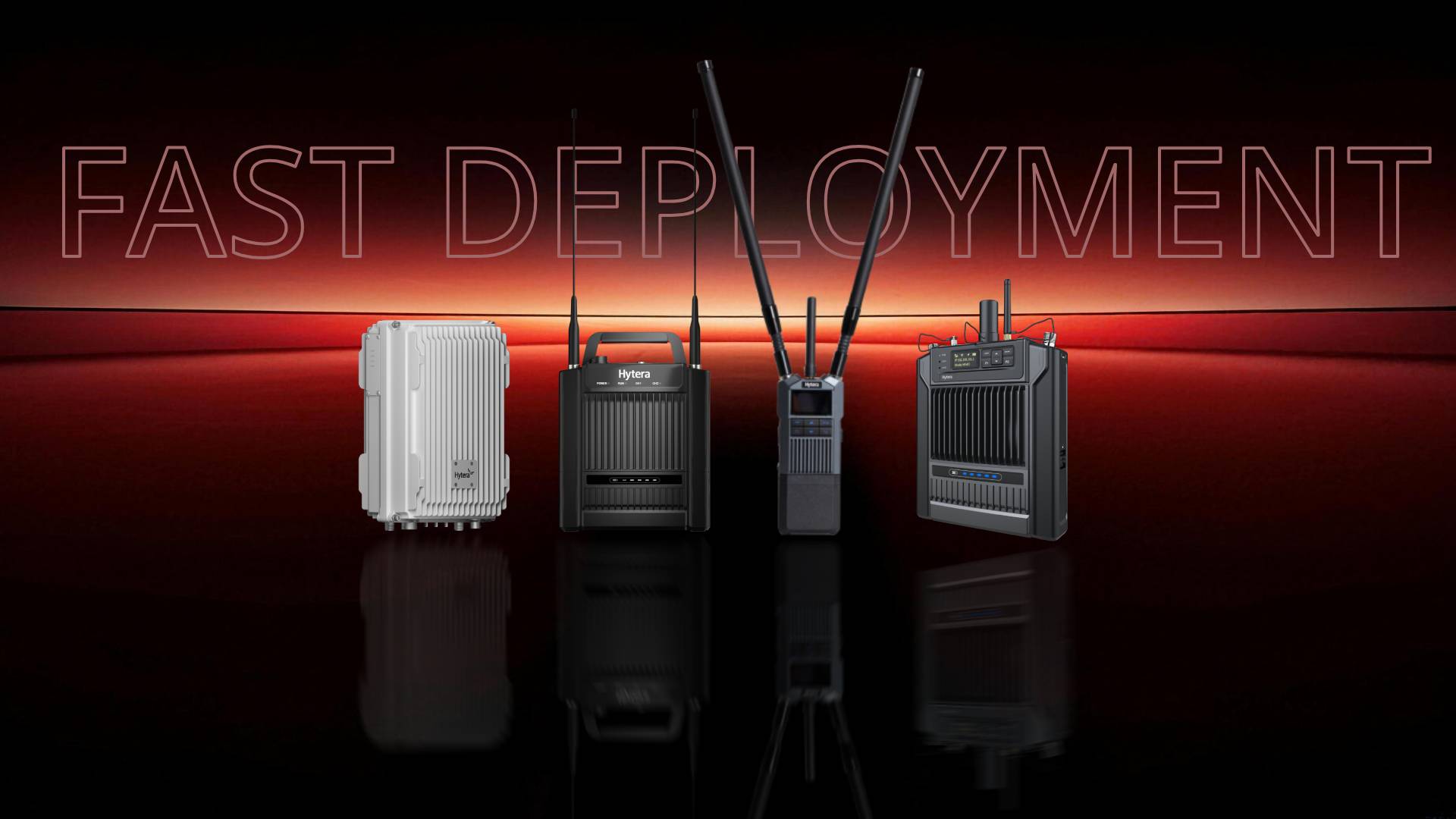
A key part of this approach is the E-pack series, which focuses on fast-deployable, infrastructure-independent communication for frontline response. Rather than relying on fixed base stations or public networks, E-pack solutions are designed to be brought directly into the incident area and activated within minutes.
For larger or more complex response scenarios, the E-pack200 provides enhanced coverage and redundancy by combining multiple roles — including radio, repeater, and network node — within a single portable unit. Its dual-channel design and ad-hoc networking capabilities allow response teams to extend coverage dynamically as operations expand, ensuring continuous group communication even when teams are dispersed across wide or obstructed areas.
Beyond narrowband voice communications, modern emergency response increasingly requires broadband connectivity to support data-intensive applications such as video, mapping, and real-time situational awareness. This is where E-mesh solutions play a critical role.
Hytera's E-mesh systems are designed to establish portable broadband self-organizing networks that function without pre-existing infrastructure. By forming resilient mesh topologies, E-mesh nodes can deliver stable, high-throughput connectivity across disaster zones, command posts, and mobile units. This enables responders and commanders to share live video feeds, location information, and operational data, significantly improving coordination and decision-making.
Across both the E-pack and E-mesh product families, several core design principles remain consistent:
*Rapid deployment: Systems are designed for immediate operation with minimal configuration, enabling communication to be established as soon as responders arrive on scene.
*Infrastructure independence: Solutions continue to operate even when public networks or fixed communication facilities are unavailable.
*Scenario adaptability: Devices are engineered to support diverse deployment environments — from urban disaster zones and remote wilderness to confined or elevated spaces.
* Flexible carrying and mounting options: Equipment can be hand-carried, worn as a backpack, vehicle-mounted, or integrated with unmanned aerial platforms, allowing communication nodes to be positioned wherever connectivity is most needed.
*Scalability and flexibility: Networks can expand or adapt as response operations evolve, without interrupting ongoing communications.
*Operational reliability: Equipment is engineered to perform under extreme conditions, supporting continuous communication during critical moments.
Rather than treating emergency communication as a system used only during disasters, Hytera's approach supports daily operations, training, and preparedness. This ensures that when a crisis occurs, responders are already familiar with the tools they rely on — and that communication remains dependable when it matters most.
Effective emergency communication solutions are built not just on technology, but on experience, interoperability, and a deep understanding of real-world response environments.
Conclusion: Rethinking Emergency Communication Before the Next Crisis
When communication fails, emergency response slows, coordination breaks down, and risks increase. The growing frequency and complexity of disasters make it clear that emergency communication can no longer be treated as an afterthought or an extension of everyday connectivity.
Understanding the fundamental differences between public networks and mission-critical communication is the first step toward preparedness. Organizations that invest in resilient, interoperable, and adaptable communication systems are better positioned to respond effectively when crises occur.
When networks go dark, preparation determines whether communication survives — and whether responders can do their jobs safely and effectively.
FAQ
1. Why do mobile networks often fail during natural disasters?
Public mobile networks are designed for efficiency under normal conditions — not for extreme scenarios. During disasters, networks may fail due to:
· Physical damage to base stations or power systems
· Overload caused by sudden traffic surges
· Backhaul or core network disruptions
Even when infrastructure remains intact, congestion alone can render services unusable. Emergency communication systems are built with redundancy, priority control, and infrastructure independence to mitigate these risks.
2. What is the difference between public communication networks and mission-critical communication systems?
Public networks prioritize speed, capacity, and cost efficiency. Mission-critical systems prioritize:
· Guaranteed availability
· Instant group communication
· User prioritization
· High reliability under failure conditions
In emergencies, reliability and coordination are more important than bandwidth. Mission-critical communication is designed for continuity when conditions are unstable or unpredictable.

Linda Li
Related Articles
 Hytera Global
Dec 04, 2024
Linda Li
May 31, 2025
Hytera Global
Dec 04, 2024
Linda Li
May 31, 2025